Inside a Sextortion Email Attack: Psychology, AI, and Enterprise Defense

Get reasoning, in your inbox.
Threat research and field notes from inside customer inboxes. Twice a month, no spam, unsubscribe anytime.
Keep reading .
More from the StrongestLayer team.
Threat research, customer stories, product updates, field notes from inside real inboxes.
Deep-dive analyses on AI-generated phishing, BEC, QR-code phishing, and adversary-in-the-middle attacks.
Hosted by Alan LeFort & Karen Letain. The cybersecurity shifts that actually matter, every other week.
Sextortion scams are social-engineering email extortion attacks that leverage fear, shame, and urgency rather than any true technical compromise. Attackers claim to have hacked the victim’s webcam or computer and obtained embarrassing videos, then demand cryptocurrency to prevent exposure. In reality, these attackers typically have no actual access to the victim’s device or private videos. They rely on leaked credentials, personal data, and psychological manipulation to convince victims they are in immediate danger. Victims often experience intense panic (“fear is the malware”) that short-circuits rational thinking, leading some to pay.
Sextortion emails have evolved from opportunistic scams into highly scalable psychological attacks. Instead of relying on sophisticated malware or technical exploits, today's attackers combine leaked credentials, publicly available information, cryptocurrency payments, and AI-generated content to create the illusion of complete compromise. The objective isn't to prove they've hacked your device—it's to make you believe they already have.
Modern sextortion has evolved with technology. Attackers now use artificial intelligence (AI) to personalize emails at scale, create deepfake images/videos, and harvest personal data from social media and leaked breaches. A 2025 analysis found scammers using Google Maps images of victims homes and stolen email passwords to make extortion emails “feel real”. Critically, these scams exploit human vulnerabilities. Psychological research confirms that intense fear greatly increase compliance.
For individuals, the solution is simple: don’t engage, don’t pay, and quickly change any compromised passwords. Forward the email to authorities (e.g. [email protected] in the UK) and block the sender. Understand that including a real password is a red herring from an old data breach, not proof of a hack. For organizations, sextortion demands enterprise attention too. Employees threatened with sextortion may panic or inadvertently expose corporate data. Security teams should treat sextortion emails as a socio-technical threat: detect them via language patterns and IOC analysis, contain incidents, reset credentials, and support victims. Organizations can train staff on spotting sextortion lures and implement AI‐driven email filtering to spot the coercive intent.
The Attack: Personal Story & Threat Overview
Imagine checking your email. Suddenly you see a new message with the subject line “Your password is Sun@shine42 - I Know everything”. The email says “I am a hacker with access to your PC… I have a video of you… If you don’t pay in Bitcoin within 48 hours, I will send it to all your contacts.” Your heart races, palms sweat, and you notice the email even includes one of your old passwords. For a moment, it feels real and personal. (This is the opening scene of a typical sextortion scam.)
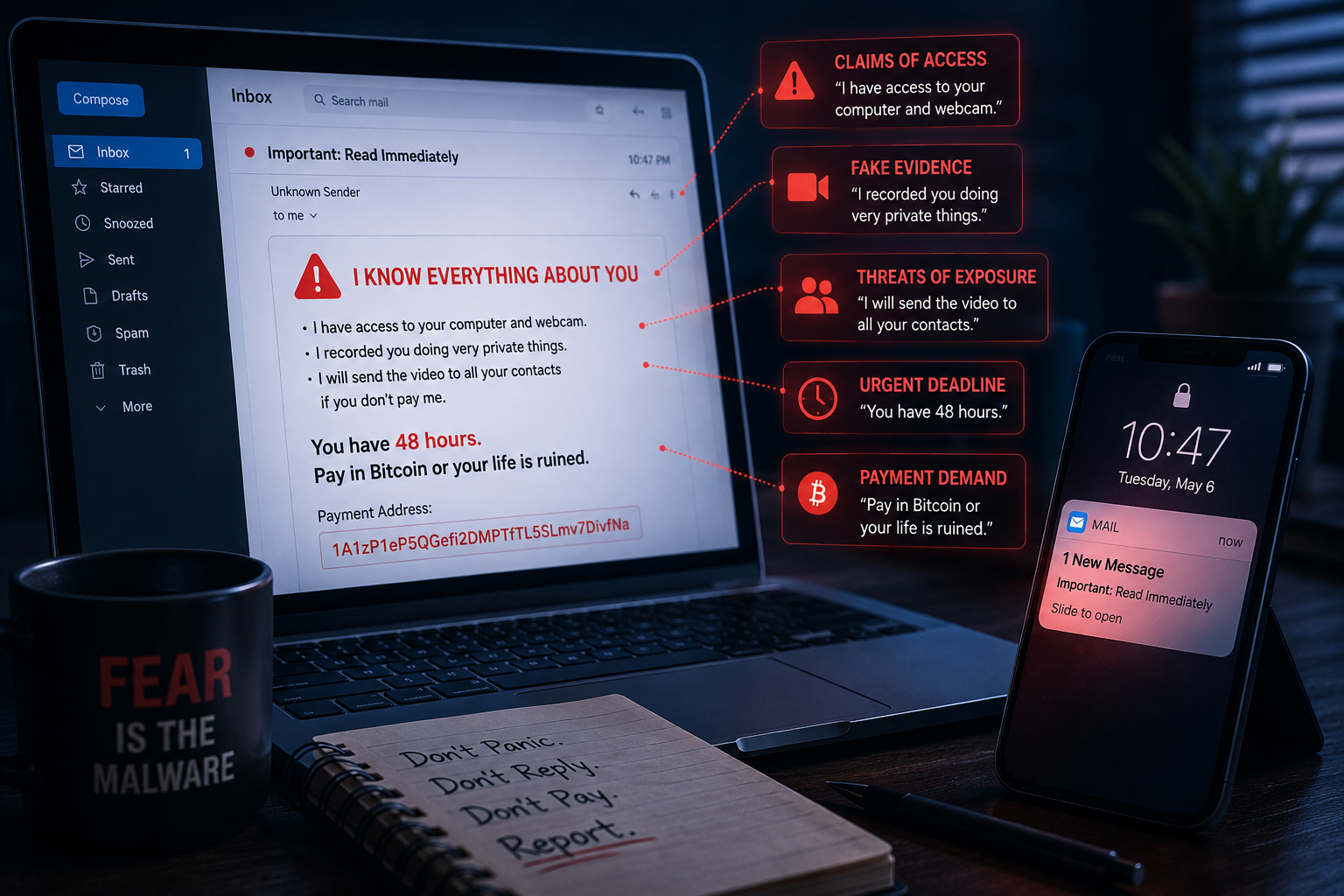
Fear Is the Malware
Sextortion exploits deep-seated emotions. The email threatens social humiliation (“we’ll send the video to your colleagues, Friends and Family”), loss of reputation, and urgent deadlines (“48 hours or else”). These are classic persuasion techniques. Research in communication and psychology shows that increased fear leads to greater compliance. Gass and Seiter found a positive linear relationship between fear intensity and persuasion: the more threatened people feel, the more likely they are to obey the demand. Attackers amplify this by using immediate deadlines (the notorious “48 hours!”) to prevent victims from thinking clearly or seeking advice. Every hour that ticks by raises anxiety, pressuring victims to act without consulting anyone.
Another lever is shame and guilt. A sextortion email implies the victim was engaging in private sexual activity (often something taboo). The attacker says, in effect, “I know your secret.” Shame is a powerful motivator; people in committed relationships may fear hurting a partner, and in extreme cases shame can lead to self-harm. Sociologist Cassandra Cross notes that offenders “influence the perception of the victim that they [the offender] do have those images,” even when they do not, using to isolate the victim. In short, sextortion targets your biggest fears – humiliation, exposure, loss of control – rather than relying on technical intrusion.
“Every element [of a sextortion email] is designed to trigger panic and prevent rational analysis,” explains one security researcher. The “core leverage is shame,” since most people would do almost anything to avoid exposing an intimate video or browsing history. The attackers know that fear is stronger than skepticism in the heat of the moment.
This emotional calculus is why sophisticated attackers may invest minimal technical effort. A recent analysis of a real sextortion campaign found no malware or system compromise at all. Instead, the campaign was entirely “behavior-driven”: tens of thousands of emails sent by rotatable cloud servers and scripted wallets, banking entirely on human reaction. As one researcher concluded, “the primary attack vector is human behavior, not technical vulnerability”.
Anatomy of a Sextortion Email
Despite the variety of scams reported, most sextortion emails share a clear structure. Breaking it down line-by-line reveals the psychological triggers:
- Subject Line: Often simply “Your password is [REAL_PW]” or a variation of “Don’t ignore this.” Including a real password from an old breach adds plausibility. Example: Subject: “Your password is qwerty123 - I know all about you.” The goal is to startle the recipient into reading.
- Opening Salvo: The first lines claim the attacker has hacked your device or account. E.g., “I installed malware on your computer, accessed your webcam, and recorded you.” This framing creates the core fear hook.
- “Proof”: Next, the email “proves” access. This is often just restating the password or mentioning some public detail. Sometimes a screenshot of a website or even a Google Maps photo of the victim’s home is thrown in. (Security researchers recently noted criminals using Google Street View images of victims’ houses to make emails more convincing.) However, no actual files or attachments are included – if you have a webcam recording, they would either send a small video clip or link, not a text email.
- The Threat: A clear blackmail demand: “Pay $[amt] in Bitcoin or we will send the video to ALL your contacts.” The threat may describe the supposed video (“left half of screen: you self-pleasuring… right half: porn video”), to maximize disgust and shame. Some list friends, family, or colleagues to personalize it.
- Payment Demand: Almost always cryptocurrency (Bitcoin). The email provides a wallet address and often a countdown. The attacker says “transfer [X] BTC to this address within 48 hours.” Victims are told this is untraceable and final. (In truth, blockchain analysis can identify payments and wallets.)
- Follow-up: Many scams conclude with a stern final paragraph: “If I don’t receive Bitcoin, your video goes to everyone (peers, bosses, relatives). If you pay, I will delete it and never bother you again.” Sometimes they add “I have a unique pixel in this email and know you’ve read it,” to claim tracking.
Here’s a concrete example of typical wording (composed from multiple scams):
Subject: Your password is Sun@shine42 - I know everything

I am a hacker who has access to your operating system. I made a video showing how you satisfy yourself while watching adult content. With one click, I can send this video to all your email contacts and social media friends. To prevent this, transfer $1,900 to my Bitcoin address 1A1zP1eP5QGefi2DMPTfTL5SLmv7DivfNa within 48 hours. After payment I will delete the video and you will never hear from me again. If I do not get the Bitcoin, I will send your video to all of your contacts.
Every line plays a role: the password builds credibility, the vague hacker persona implies expertise, the Bitcoin address and deadline enforce urgency.
Key takeaway: A sextortion email looks like a confident, urgent blackmail note. It will never contain an actual video attachment (that would be self-incriminating for the attacker), nor any malware download. The “evidence” they offer is just words and the psychological weight you give them.
The Sextortion Confidence Pyramid: Why Victims Believe the Bluff
Every successful sextortion campaign relies on one simple principle: the attacker doesn't need to prove they've compromised you—they only need to make the story feel believable.
Think of a sextortion email as a confidence pyramid. Each layer adds psychological credibility, even though it rarely provides evidence of a real compromise.
Level 1: The Generic Threat
At the base of the pyramid is a message that could be sent to anyone.
The attacker claims to have hacked your computer, recorded your webcam, or stolen private videos. These statements are intentionally vague because they require no proof. Millions of identical emails are sent every year with only the recipient's email address changed.
Reality: Generic threats create curiosity—not credibility.
Level 2: A Real Password
This is where panic usually begins.
Seeing an actual password immediately changes the emotional response from:
"This is obviously spam."
to
"Wait... how do they know that?"
In almost every case, the password originated from an old data breach or credential dump rather than an active compromise. Attackers understand that people naturally assume any accurate personal information must have come from hacking their current device.
Reality: A leaked password is evidence of yesterday's breach—not today's compromise.
Level 3: Personal Information
Modern campaigns increasingly include details such as:
- Your full name
- Phone number
- Employer
- Job title
- City
- Home address
None of this necessarily indicates unauthorized access. Much of it can be collected from social media profiles, public records, data brokers, or previous breaches.
The goal is simple: replace uncertainty with perceived certainty.
Reality: Public information is often mistaken for private intelligence.
Level 4: Environmental Context
Some campaigns now include:
- Google Street View images
- Photos of nearby roads
- Satellite imagery
- Maps of your neighborhood
These additions create the illusion that someone has physically located you.
In reality, the attacker has usually done nothing more sophisticated than searching an address using publicly available mapping services.
Reality: Familiar surroundings increase fear—not attacker capability.
Level 5: AI-Generated Evidence
The newest evolution involves generative AI.
Attackers can now create convincing fake screenshots, fabricated chat conversations, cloned voices, or synthetic explicit images that appear highly authentic. None of these require prior access to your devices.
This represents the most dangerous layer because victims often interpret realistic-looking media as undeniable proof.
Reality: Artificial intelligence is making fabricated evidence more convincing, not making attacks more technically sophisticated.
The Reality: Why These Claims Are Empty
When we strip away the bluster, we see the truth behind the sextortion scam:
Credential Leaks and Password Reuse
The one detail that sends victims into panic is seeing their real password in the email. But nearly all of these passwords come from data breaches, not a live hack. Over the past decade, billions of email/password pairs have leaked from hacked services (LinkedIn 2012, Adobe 2013, Collection #1, etc.). Scammers buy these breach dumps cheaply and use them to personalize emails en masse. You probably used that password years ago on some site. It has NOTHING to do with your current activities or your webcam.
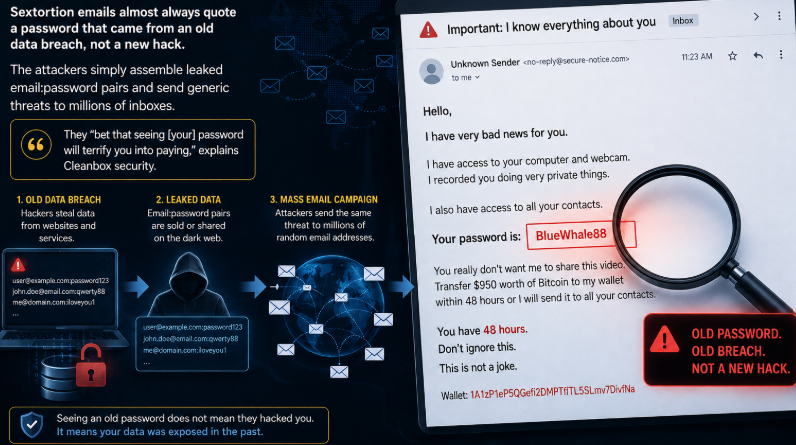
Because password reuse is so common, your leaked password was likely dumped in the same forum as thousands of others. Scammers send out hundreds of millions of emails and know a tiny fraction (usually <1%) will yield a payment. The math favors them: even a 0.1% success rate on a million emails can net tens of thousands of dollars. (Blockchain analyses of prior campaigns show payment rates typically below 1%.)
Why Seeing Your Password Doesn’t Mean a Hack
It’s understandable to fear the worst when your own password is exposed. But the presence of your password in the email is a ruse. As NCSC (UK) advises: “Don’t worry if the message includes your password, as it is probably from an old breach of personal data. But you should change your password immediately”. No modern sextortion relies on actually cracking your machine. There’s no Remote Access Trojan, no installed malware, no live control of your system.
Indeed, forensic investigations confirm this. Cisco’s analysis of 233,236 sextortion emails found no technical evidence of compromise – the criminals simply listed passwords and claimed they had remote access. The same was true in a 2026 campaign study: “No evidence of malware, system compromise, or persistence mechanisms was identified. The attacker relies on distributed infrastructure … email delivery involves spoofing and SMTP anomalies”. In other words, the scam is entirely psychological.
So if you see your password, assume one of two things happened: either it leaked in an old breach (very common), or you might have accidentally given it away through a phishing test or unsafe site. In either case, immediately update that password wherever you used it. But understand that your computer has not been hacked at this moment. The attackers didn’t need to install anything to grab the password; they just acquired it from a dump.
Common Myths Debunked
- Myth: “They must have a video because they know my password.” No. The password came from a breach, not a webcam hack. Attackers routinely have no actual evidence except your fear. A recent analysis notes attackers “influence the perception of the victim that they do have [images]… Offenders use shame to intimidate and isolate the victim”. But almost never do sextortion emails include real videos or screenshots.
- Myth: “If I pay, they’ll delete everything and leave me alone.” Not guaranteed. The UK National Crime Agency warns: “You may be tempted to pay, but there is no guarantee that this will stop the threats… once you have shown you can pay, they will likely ask for more”. Paying a ransom validates the attacker’s strategy, and criminals often try repeatedly. Security experts advise never to pay. There is no contract or trust – they have your Bitcoin and little incentive to stop.
- Myth: “They will take my money and delete it, then it’ll be forever.” No contract. Even if you pay, the attacker can never truly prove deletion, nor can they easily repay you for a “mistake.” And because they have your address, they may try shaming again later.
- Myth: “If I ask for proof (like ‘Reply Yea!’), they will send a clip.” Don’t do it. This only confirms your address is real and that you’re a worried target. It encourages them to continue or even verify your contact for resale to others.
- Myth: “This is definitely real, so I should pay.” Stop. Legitimate companies or law enforcement do not demand Bitcoin ransom via random email. No criminal will ever help you. The safest move: block the sender, change your passwords, and report the email to authorities.
Understanding these myths is crucial. No legitimate hacker or antivirus company will send random blackmail emails. Recognizing the bluff is step one in resisting it.
The Evolution of Sextortion Tactics
Sextortion as a concept is not new, but technology keeps changing how it’s executed. We’ve seen three major trends in recent years:
Beyond Webcams: Deepfakes and OSINT
Early sextortion emails often explicitly claimed to have “webcam footage” of the victim. Today’s criminals can embellish with AI and open-source intelligence (OSINT). According to law enforcement, attackers now superimpose victims’ faces onto porn videos using generative AI, or manipulate existing images. They scrape social media and data leaks for personal details (real name, workplace, hobbies) to make emails scarier. An Avast report notes scammers added Google Maps photos of victims’ homes and names of local streets to personalize threats.
Attackers are also using information from public profiles: conference photos, LinkedIn descriptions, published articles. If your LinkedIn photo or Twitter account is public, they can caption it “my recordings of you.” Some sextortion scams impersonate a person you know (e.g. “Friend Account”), or a plausible authority (a “cyber unit”). Even social media platforms are being weaponized: some criminals start as faux friends online, coax victims into sharing an image, then extort with it. In short, sextortion tactics have grown sophisticated as attackers blend technical trickery with traditional social engineering.
The AI Era: Smart Spam and Perfect English Threats
Artificial intelligence, especially large language models, has given scammers powerful new tools. Now emails can be hyper-personalized at scale. AI can generate convincing, well-written texts in any language, making it harder to spot non-native phrasing. A campaign might use GPT-style models to write each victim’s email in fluent English or the target’s native language, even referencing local events for credibility. Some attacks involve chatbots playing roles (the “interviewing hacker” or “sympathetic policeman”) to coax information or obedience in real time.
Criminals also leverage AI for voice and video deepfakes. For example, an attacker could call via VoIP using a cloned voice of a known authority (like a police officer) to warn of imminent arrest if the ransom isn’t paid. Or they might send a video message with a convincingly dubbed voice saying “I’m watching you”. Reports already warn that AI is being used to create fake explicit images and videos with superimposed faces. As voice-synthesis improves, it’s only a matter of time before sextortion melds with vishing: imagine a realistic “webcam footage” played in a live video call.
LLMs also allow attackers to conduct mass campaigns with context awareness. They can query databases for news about targets (e.g. “I see from your LinkedIn you spoke at [Conference] last year.”) and weave that into the email. Machine learning models can help generate thousands of unique email variants, test which wording elicits more payments, and continuously refine tactics. The scalability is enormous: an AI-driven campaign might send millions of custom-tailored threats without human typo, vastly outpacing manual spam.
This convergence of sextortion and AI means each attack will seem more plausible. An executive reading a deeply personalized, grammatically perfect threat may be more easily fooled. Fortunately, AI can also be part of the defense – see below.
Enterprise Defense: Why and How Organizations Must Act
Sextortion is often framed as an individual’s problem, but enterprises face serious stakes too. When an employee (especially a high-profile one) gets a sextortion email, it can ripple through an organization.
Why Enterprises Should Care: Organizations must take these attacks seriously for several reasons:
- Employee Panic: A terrified employee might inadvertently expose corporate systems. For example, panicked users could plug work devices into untrusted networks or share login details out of confusion. They may also flood helpdesks asking “Did I get hacked?” and overload support teams.
- Credential Reuse Risk: If the leaked password is for a work account, attackers can try credential stuffing on corporate networks. Even personal accounts may use similar or related passwords. Many corporate breaches start this way.
- Insider Threat/Lateral Impact: In some sextortion campaigns, attackers don’t ask for money at all but for information or access. As one analysis notes, “sophisticated sextortion campaigns sometimes request internal company information instead of money”, targeting specific high-value employees for credentials or proprietary data. If an HR director receives a sextortion threat, for instance, the scammer might demand employee records or database access.
- Reputational and Legal Risk: News of sextortion calls (e.g. a leaked executive video) can damage company reputation. Even if false, rumors can spread quickly. Companies may also face liability if personal data leaks occur (e.g. leaked passwords used).
- Operational Overhead: Security teams will need to investigate and contain each incident. The FBI’s IC3 (Internet Crime Complaint Center) receives tens of thousands of sextortion reports annually. Corporations can expect some of those calls, especially in sectors like finance, tech, or government.
Importantly, employees may be embarrassed to report these attempts. Sami Eltamawy’s research notes: “The secretive nature of these attacks means they often go unreported to IT. Employees under the emotional weight of potential exposure are reluctant to involve colleagues, creating security blind spots”. This means an attack could persist undetected if no one raises the alarm. Security leaders must break the stigma and encourage reporting, just as with other phishing attempts.
Security Team Response Checklist
When a sextortion email is reported, incident responders should follow an adapted playbook:
- Identify & Classify: Confirm the email is sextortion (e.g., it contains coercive content, password, threat, BTC address).
- Do Not Engage: Advise the user to not reply or pay. Treat it as a scam.
- Contain: Block the sender’s email domain/address across the organization. Add any Bitcoin wallet addresses to threat intelligence lists (they are often reused). Ensure any URL or attachment (though rare in sextortion) is quarantined.
- Verify Compromise: Check if any malware or intrusion indicators exist in the employee’s device or network logs. (Typically there won’t be – but confirm no breach occurred.)
- Reset Credentials: If the extorted password is for a corporate or important system, force a password change and reset sessions/MFA for that account. The NCSC advises changing “anywhere else you use the same password”.
- Threat Hunting: Search email logs for similar messages sent to other employees. Attackers often send thousands of similar emails. Look for repeated Bitcoin addresses or phrasing.
- User Communication: Send a company-wide notice (maintaining confidentiality) that emphasizes “no user was actually hacked” and reminds staff of the phishing advice. (Avoid sharing fear-inducing details; emphasize facts.)
- Legal/Escalation: If payment demands are significant, involve legal counsel or law enforcement. For example, in the US one can report to IC3, or to cybercrime units in other countries.
- Incident Documentation: Record the event in your incident management system. Note all IOCs for future reference.
Technical Indicators and IOCs
Unlike a phishing email carrying malware, sextortion emails offer few technical clues beyond content and sending patterns. However, SOC analysts can still identify several indicators:
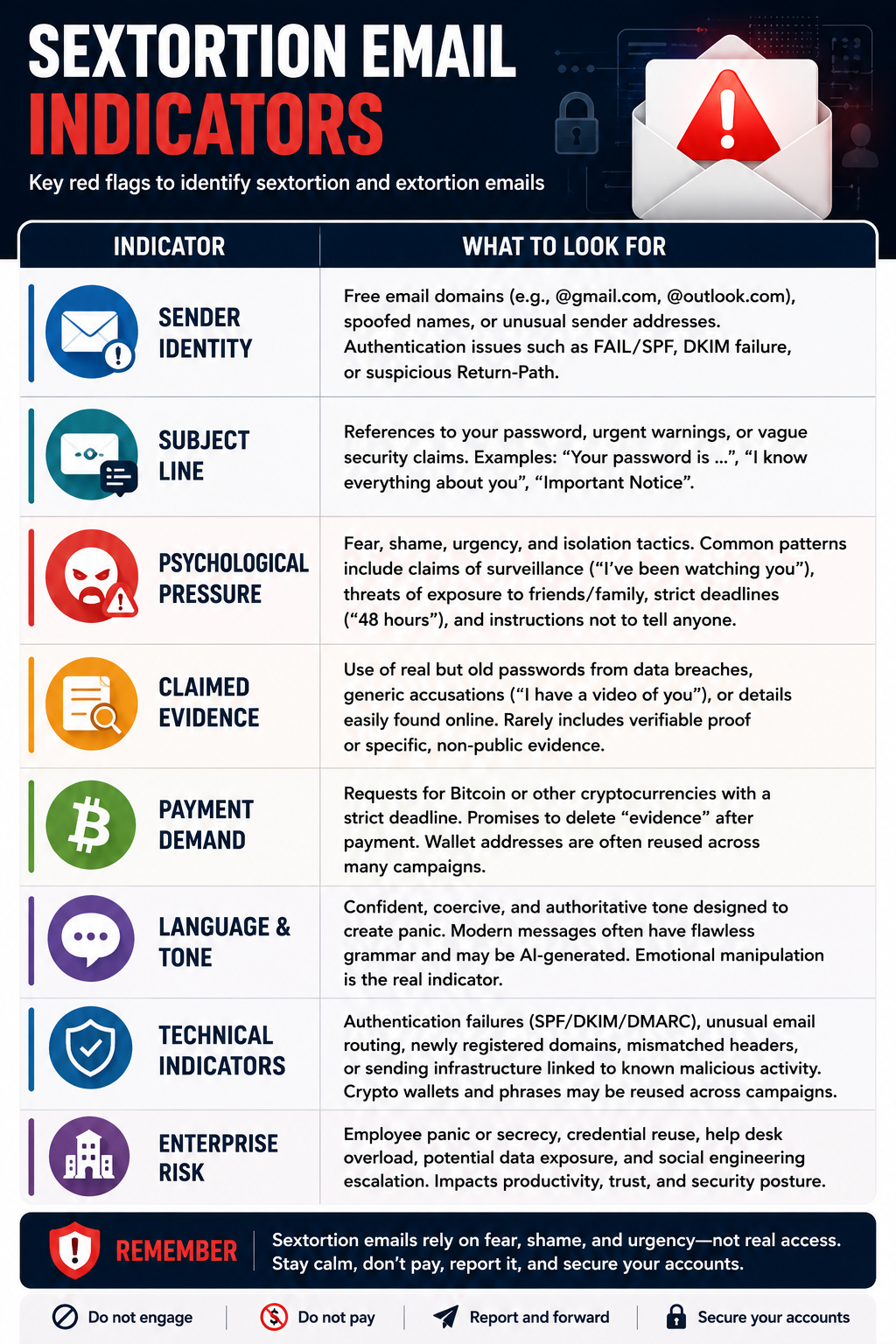
For detection, key patterns include the unique subject-password pairing and presence of cryptocurrency instructions. Enterprise email gateways can flag incoming messages with content matching these traits. For instance, filters could look for password patterns (e.g. an @ followed by alphanumerics), keywords like “webcam”, “Bitcoin”, “address”, or typical extortion phrases.
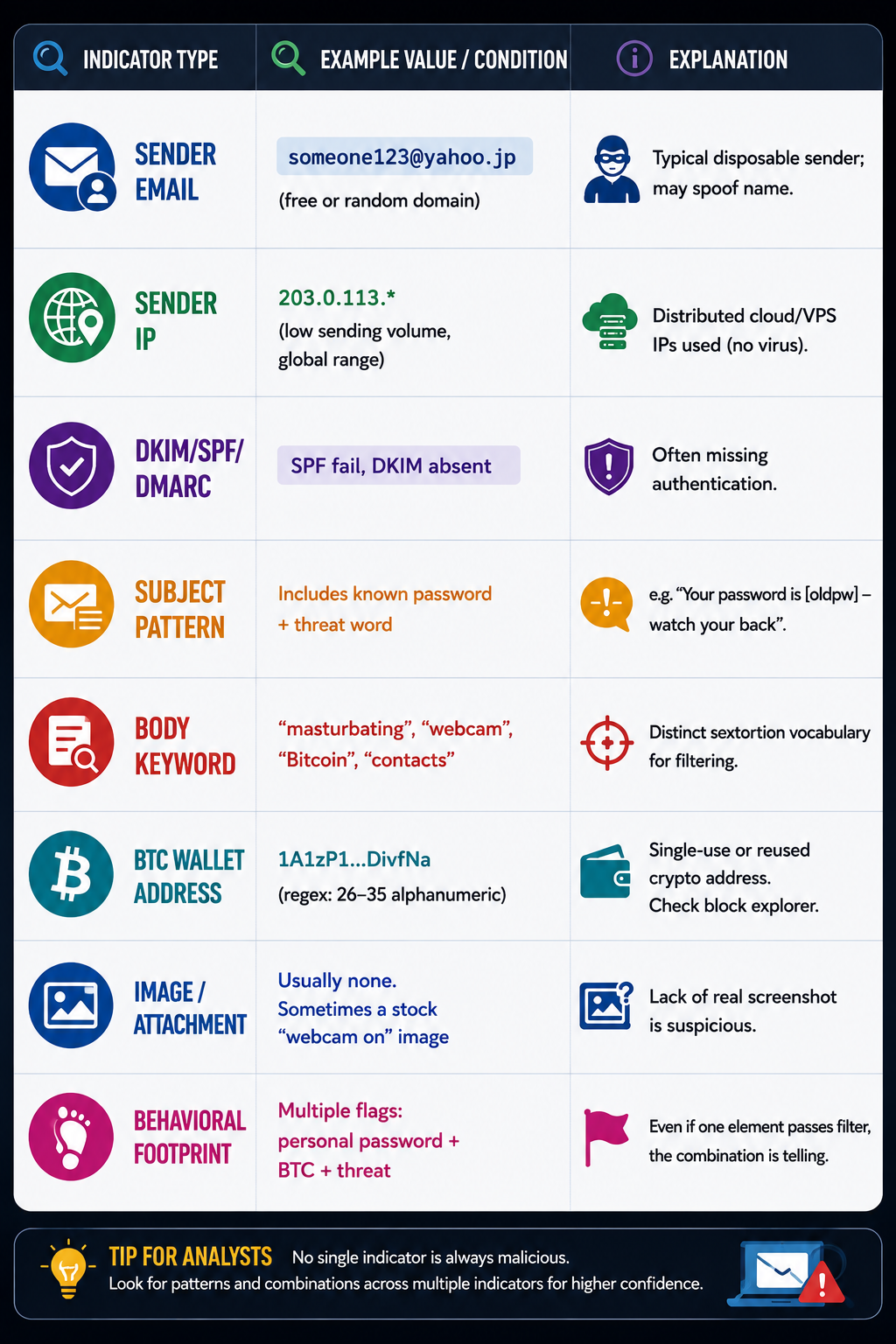
Advanced defences: Some organizations now apply NLP-based classifiers (AI) to detect extortionate intent in text. A trained model can identify the “tone” of blackmail (similar to detecting BEC or ransomware requests). However, because sextortion emails don’t contain malware, hosts rely on content intelligence and threat context. Sharing indicators with threat intel networks (e.g. domain names, wallet IDs) helps everyone – past campaigns often reuse components.
Can AI Help Detect Sextortion?
Yes – the same AI that scammers use can help defense teams spot these scams. Instead of looking for a virus signature, AI-based email filters analyze the meaning and behavior of messages. For example, modern email security platforms use NLP models to understand intent. They can flag phrases like “I recorded”, “send contacts”, or any mention of sensitive topics plus a demand. An AI might measure the emotional sentiment or urgency of an email and raise a red flag if it matches learned patterns of extortion.
StrongestLayer’s 2026 analysis notes that AI email security “understand[s] an email as a human would,” catching hidden cues. In practice, an AI filter could be trained on examples of sextortion emails vs. normal correspondence. It would learn to recognize the coercive semantics – for instance, a message promising secret exposure unless a payment is made. Similarly, machine learning can profile writing style anomalies; a well-known vendor or person writing in all-caps demanding Bitcoin would stand out.
Another approach is using specialized algorithms on threat intelligence to correlate blockchain data. AI-driven blockchain analysis tools can flag repeated patterns – e.g. if your company’s domain appears in extortion messages tied to certain wallets. Machine learning could also classify unknown wallet addresses by similarity to known sextortion wallets (transaction flow, aggregation patterns).
In sum, AI detection of sextortion focuses on language and behavior, not malware signatures. Queries to AI-based security might be: “Does this email threaten exposure?” or “Is this message using fear appeals?” A sophisticated system might even query: “Does this Bitcoin address appear across multiple threats?” through connected blockchain intelligence. While no tool is perfect, AI is uniquely suited to spot the psychological and textual signals of a sextortion scam.
Building Enterprise Resilience
Combatting sextortion in a business environment requires a multi-layered strategy:
- People (Training & Culture): Educate employees that sextortion is a scam. Include examples in awareness training (as Sami Eltamawy suggests) so staff recognize the telltale signs: claims of infection, demands for Bitcoin, urgency. Emphasize that legitimate authorities never ask for payment like this. Encourage reporting; assure staff that feeling targeted isn’t shameful. A supportive culture removes the stigma that keeps victims silent.
- Policies: Enforce unique password policies and mandatory password managers so stolen credentials become useless. Implement content/URL filtering: block known adult or malicious sites on corporate networks. As one defense strategy notes, if adult content is already blocked on work devices, any sextortion claim of streaming would be obviously false. Also, define incident response procedures for sextortion specifically (similar to phishing or BEC IR plans).
- Email Security Technology: Use advanced filters (AI-based or rule-based) to catch sextortion. For example, create DLP or anti-spam rules for keywords like “webcam”, “masturbating”, “crypto”. Leverage StrongestLayer’s AI email security and anomaly detection to spot socially-engineered threats. Ensure your secure email gateway enforces SPF/DKIM/DMARC so spoofed addresses stand out.
- Threat Intelligence (TI) & IOCs: Maintain an updated list of known sextortion wallet addresses and domains. Share and subscribe to TI feeds that include extortion campaigns. Integrate this with SIEM or SOAR to automatically flag incoming emails containing these indicators. Use behavioral analytics: e.g., if a normally quiet mailbox suddenly gets multiple extortion messages, alert the SOC.
- Incident Playbooks: Add sextortion-specific steps into your SOC runbooks. This includes who to notify, how to advise the victim (change passwords, ignore extortion), and how to escalate if needed. For example, if an executive receives a threat, the CISO and PR teams may need to be briefed proactively (even if it’s a hoax) to manage panic.
By preparing people and systems in advance, a company turns sextortion attempts from emergencies into standard incidents. As one expert notes, the best defense is preparedness – teaching staff the predictable pattern of these scams ensures any new attack is recognized for the fraud it is.
Reflection and Future Trends
The Victim’s Psychology Timeline
It is helpful to visualize how an email translates into action via emotional stages. Below is a timeline of a victim’s likely reactions to a sextortion email:
- Shock: Opening the email, seeing a real password.
- Denial / Disbelief: Attempting to rationalize it away (“Scam!”).
- Fear & Anxiety: Doubting themselves (“What if they do have footage?”).
- Urgency: The deadline triggers panic.
- Isolation: Victims often feel embarrassed, so they don’t share the incident with friends or IT.
- Compliance: Eventually, to stop the pain, some may send money.
(Thankfully, not everyone reaches payment. But even those who pause at “Fear & Anxiety” deserve reassurance and clarity.) Drawing attention to each phase can help security trainers and responders address the emotional narrative of a sextortion attempt.
Future of Sextortion: Deepfakes, AI, and Beyond
The cat-and-mouse game will continue as technology advances:
- Deepfake Videos & Real-Time Extortion: In the near future, attackers could use generative models to create realistic fake videos of the victim. Imagine an AI that generates an hour-long “home video” of you using synthesized imagery, complete with cryogenic audio of you speaking. Even if it’s entirely fake, a victim may still panic. Similarly, real-time video calls with fake voices (“the police are on the way”) could emerge.
- Agentic AI: Sophisticated attackers may deploy AI agents to gather intel on each victim individually. An autonomous script could scour social media for data, craft personalized emails, negotiate if replied to, and even learn which tactics elicit payment. This multi-round interaction would make sextortion feel like a targeted scam rather than a one-shot email.
- Cross-Channel Extortion: Currently mostly email-based, sextortion might branch out. Text messages, social media DMs, or even phone calls could relay similar threats (particularly in regions where email isn’t primary). We may also see collaboration: imagine a phishing email that first tricks you into a video call with a fake interviewer, who then transitions into extortion.
- Synthetic Identities: Attackers may use stolen photos and deepfakes to pose as specific acquaintances or even celebrities known to the victim, increasing trust (“It’s me, your cousin, please help”).
- International Collaboration: Organized crime rings (for example, West African networks) may adopt these AI tools en masse. Conversely, law enforcement is starting to share AI tools across countries.
All this underscores the conclusion: Sextortion’s power lies in its psychological impact, not secret technical hacks. Future defenses must match in sophistication, using AI and human insight to identify malicious intent before it breaches the human mind.
Final Thoughts
Sextortion emails succeed not because attackers have technological mastery over you, but because they manipulate your emotions. They craft a terrifying scenario and prey on secrecy to paralyze rational thought. But every scammer’s tactic is ultimately a bluff backed by fear. No, they haven’t “hacked” your webcam in most cases, even if the email claims so. They have your old password and your sense of dread, which together form the attack.
For defense, focus on the intent behind the message. Modern security must detect malice in content, not just code. AI-based email security excels at this – it analyzes semantics, intent, and atypical communication patterns rather than only scanning for known malware. Ultimately, the best protection is awareness: understanding that the true “attack vector” is fear itself, and refusing to let panic be the final exploit.
Frequently Asked Questions (FAQs)
Q1: What is a sextortion email?
A sextortion email is a scam message claiming the sender has compromising sexual images or videos of you (often via webcam) and demanding payment to keep them private. In reality, these emails are fake threats used to blackmail victims for money.
Q2: Are sextortion emails real threats?
The emotions they provoke are real, but the technical claims usually are not. Most sextortion emails do not come from an actual hack. They’re scams exploiting fear. Always treat them as fraud, not genuine exposure.
Q3: Should I pay the attacker?
No. Security experts universally advise against paying. Paying does not guarantee the fraud stops; attackers often demand more and have no obligation to delete anything. Instead, report the email, block the sender, and change your passwords.
Q4: What if the email includes my real password?
This is the scammer’s trick to frighten you. They obtained that password from an old data breach or list – not from hacking your device now. It means someone once had your password; change it anywhere you used it, but don’t panic. The attacker almost certainly does not have any current access to you.
Q5: Can sextortion emails infect my computer?
No malicious code is typically involved. Sextortion emails rely on social engineering, not malware. They usually contain no attachments or harmful links. Simply delete the email and ensure your accounts are secure.
Q6: Can businesses or employees get sextortion emails?
Yes. Any email user can be targeted – personal or corporate accounts. Attackers may target key employees (e.g. executives, HR) hoping to exploit wider access. Companies should treat any reported sextortion attempt as a security incident and follow response protocols.
Q7: How do email security tools detect sextortion?
Traditional filters may miss these (no virus, no bad link). Modern tools use language analysis (NLP) to spot coercive or urgent language patterns, known extortion keywords (webcam, Bitcoin, blackmail), and known IOCs like reused Bitcoin addresses. Threat intelligence feeds can also flag wallet addresses or domains tied to known scams.
Q8: What should I do immediately after receiving one?
Don’t respond or pay. Instead, delete or quarantine the email. Change any password shown in the email on any account you used it for. Report the email to the relevant authorities: for example, in the UK forward it to [email protected], in the US report to the FBI’s IC3. If this happened on your work email, notify your IT or security team promptly so they can take protective measures.
Q9: Are sextortion emails illegal, and how do laws vary by region?
Yes, sextortion is illegal nearly everywhere as it involves blackmail and extortion. In many countries, authorities have dedicated cybercrime units for this. For instance, victims in the UK are advised to report to local police or NCA/CEOP, while US victims use FBI/IC3. Even if your jurisdiction lacks specific sextortion laws, general extortion statutes apply.
Q10: Who should I contact if I need help?
If threatened, reach out to law enforcement immediately (police, cybercrime hotline). Many regions have fraud or cybercrime centers. For personal support, organizations like Victim Support (UK), Childline, or counselling services may offer help for emotional distress. Remember: you are not alone, and help is available.
Subscribe to Our Newsletters!
Be the first to get exclusive offers and the latest news



Catches what your gateway approved.